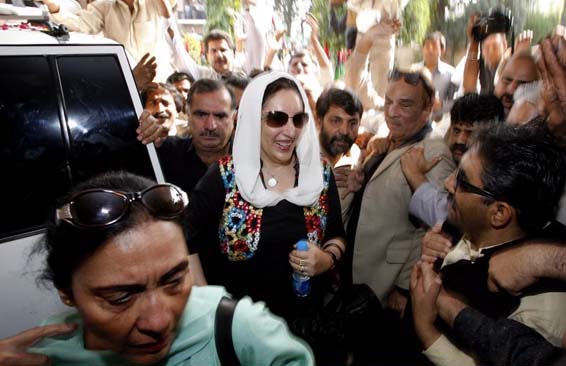
Musharraf has launched his media blitz, giving interviews to newspapers and news channels from around the world. In
an interview with Sky TV yesterday, he insisted that he is actually a democrat and that his rule is democratic (!!!) and is committed to holding elections. When asked how these elections can be considered fair when all the opposition party leadership is in jail or under house arrest, he insisted that this presented no problem:
AC: But all your main opponents are either locked up or under house arrest. Can't you see how the West finds that difficult to square?PM: No they are not locked up?
AC: or under house arrest?
PM: The main political parties, the leader, you see them on the TV, the main leader you can see on the television.
AC: They're still locked up. I did see Imran Khan, I did see the head of the Jamaat-e-Islami but they're both under house arrest or on the run. Even Benazir Bhutto is now locked up in her house?
PM: Yes, but what do you expect?
AC: how can that be free and fair, Sir?
PM: You should get to the root of the problem...
Uh... well, perhaps it belatedly occurred to someone that in fact you couldn't see the opposition leaders on TV because of the media ban. Today it seems as if Aaj TV, Dawn News, CNN and BBC have all come back on air. Geo is still banned it would seem. CNN and BBC had returned briefly on Sunday when they aired Musharraf's press conference live, but of course were duly taken off air again when Benazir held a press conference later that evening. Lets see how long they stay on air this time.
So now that we have, more or less, access to the media again, what do we see? Well, first of all there is Chaudhry Pervez Elahi, the Chief Minister of Punjab holding an election rally. Hmm... doesn't seem unusual, except... wait! Didn't the very same Chaudhry Pervez Elahi warn of "specific information" that suicide bombers had entered Lahore and that
it wasn't safe for the PPP to hold a rally? The same Chaudhry Pervez Elahi who when asked why he felt so secure in holding rallies, while at the same time citing
"specific" security threats against rallies of his political opponents, answered that his rallies were
"safe" because of the "prayers of the people"?
The same Chaudhry Pervez Elahi who was pushing Musharraf not to make a deal with the PPP and to hold elections early because
"the PML was now better placed and well-entrenched to win the polls".
No wonder Elahi is so confidant about the PML-Q's ability to do well in coming elections. After all, all the political opposition has been detained. Opposition rallies can be banned due to 'security threats', political opponents and other agitators can be arbitrarily thrown into jail, where they are made to understand that their only way out is to
become PML-Q members. And anti-graffitti and billboard laws
only apply to the opposition.... One gets the feeling that Mr Chaudhry Pervez Elahi may well become our next prime minister. (Thats the slogan that was being chanted at the rally they were showing on the TV by the way).
Something else, one got to watch on TV was the adviser to the Prime Minister on finance, Dr. Salman Shah, harping on about the wonderful performance of the government's economic policies. He insisted vehemently that the Emergency had not hurt investor confidence (as he was speaking, the stock market was in free fall by the way - it lost 300 points today), and insisted that any reservations that investors had was because of the "bad image" that the media presented of Pakistan.
Now I really know nothing about Dr. Shah, except that he used to work in the World Bank, and is supposedly one of Musharraf's most trusted advisers. I have no knowledge of his achievements or ambitions but what he said convinced me that he is a man full of sh*t who is not averse to lying in his master's cause.
He went on about how he read some report about failed states that was issued 18 months ago, which ranked Pakistan as a number 2 failed state below Somalia and above Afghanistan and that being curious, he examined the methodology of the report and found that they came to conclusion by finding 'negative' media reports from the country's media, and feeding them into a computer, which tallied the results to give a list of failed states. Thus, Pakistan's high ranking was due to its media's "negativism". The implication was that Musharraf's muzzling of the media was justified because, it was tarnishing Pakistan's image and thereby hurting its economy.
A bigger crock of sh*t I have yet to see presented by one of Musharraf's lackeys. No such report exists. No such methodology exists. And really if this is the best the government can come up with, it deserves to be torn down in quick order. This is precisely why we need a free media - to hear our leaders in their own words so that we can expose their lies.
Oh, and on the note of the government's economic policies:
Pakistan's
trade deficit is now $1.945 billion per month. And the ADB funded $1.8 billion governance reform programme is failing due to a lack of interest shown by the government in making it work. This programme was supposed to help improve governance on a local level, providing better access to justice, legal protection, and improve the ability of local government officials to understand and cater to the needs of their localities. As
this jargon littered report in Dawn quotes:
The final outcome of the reform programme may not be different from the poor results of the Social Action Programme of the 90s, says the assessment.
Another argument, perhaps, that for the vast majority of people, the current government has had as little interest in making a positive difference in their lives as the much maligned governments of the 90s did?
The government has attracted a great deal of foreign investment. But don't think that this is some kind of charity. According to CNBC, in the first quarter of 2007-08, $180 million was remitted out of the country as profit on investment. And this is before massive, now foreign-owned companies such as PTCL have announced their profits. Yes, while it hasn't been too interested in bettering the lives of the people, our government has done well by the multinationals, hasn't it?
Phew. On a slightly lighter note, a fine article on '
The Divine Right of Army Chiefs' in Pakistan.
Oh, and if anyone is wondering why a student wing of the MMA would betray Imran Khan to the police? I refer you to this report in the papers about the fact that the non-jailed political leadership of the MMA is almost unanimous in feeling that it should
not confront the establishment on the issue of the Emergency.
 The police attacked a rally taken out by students and activists to show solidarity with the deposed Judges in Islamabad on 17th December. More photos here.
 Policemen putting up hoardings bearing the bicycle on a green field symbol of the pro-Musharraf political party the PML-Q. Note the stacks of hoardings in the police pick-up.