And the rumour mill has, as usual, gone wild, with all sorts of conspiracy theories making the rounds regarding who killed Benazir Bhutto. Some claim it was Musharraf. Some claim it was her husband, Zardari. Some allege it was the Chaudhries. Some claim it was part of a larger American plot. No, others claim, its actually an Indian conspiracy....
As addicted as we are to conspiracy theories, I suppose it was inevitable that these kinds of conspiracy theories would proliferate. But the circumstances of the medical report and outlandish claims by the government immediately following the assassination have added grist to the mill. Its sad really.
Here is a STRATFOR article, reprinted at Teeth Maestro's blog, summarizing the political situation in Pakistan and examining the theory that Musharraf had something to do with the murder. It very rightly points out that Musharraf had everything to lose and little to gain from Bhutto's death.
Showing posts with label BB. Show all posts
Showing posts with label BB. Show all posts
Friday, 11 January 2008


Tuesday, 1 January 2008
Anatomy of A Dynastic Succession Struggle
A week ago Asif Zardari was in the political wilderness. Right now he is riding high as the premier political figure in the country. How did he get there and perhaps more importantly, will this state of affairs last?
That there were many in the PPP hierarchy close to Benazir Bhutto who detested Zardari is no secret. That they blamed Zardari and his corrupt and thuggish ways for staining Bhutto's reputation and alienating both popular and political support is also well known. During Bhutto's second tenure as Prime Minister, Zardari was appointed to the cabinet with the environment ministry portfolio - a post which shuffled him out of a say in important decision-making while allowing him to collect bribes in return for the no-objection certificates every building, mining and industrial project requires from the Environment Ministry before getting underway.
But convicted of corruption, Zardari was jailed and only recently released by Musharraf as part of the political deal Musharraf was making with Benazir Bhutto. Zardari high-tailed it to Dubai where it was widely expected that he would remain, with no role to play in the coming elections or any kind of future Bhutto-Musharraf government. The PPP inner circle was reputedly happy with the arrangement.
Then came the assassination.
The revival of Zardari's political fortunes is the result of several factors, which include the pressures of a modern TV news media, the nearness of elections, Benazir Bhutto's style of absolutist politics within the party which eliminated any source of power within the party outside of that of her own Bhutto name, and the personality-cult brand of leadership so deeply rooted in South Asian cultures.
In the days immediately following Bhutto's death, Zardari was thrust into the media spotlight in a manner which none of the senior PPP leaders could match. As Bhutto's husband, all the political leaders of Pakistan, from Musharraf to Nawaz Sharif contacted him to commiserate. The live media coverage of the emotional scenes of the funeral procession, burial and ceremonial prayers all depicted Zardari at the forefront - the rest of the PPP leadership was lost in the crush of the crowd. Media reporters constantly wanted to speak with and interview Zardari - he became the focal point of attention and spokesperson for the grief and loss felt at Benazir's death.
Using this media focus on him, Zardari pushed to the forefront his son Bilawal. The Bhutto name was one that the inner sanctum of the PPP found hard to deny. Efforts to bring in other Bhuttos, such as Benazir's sister, Sanam Bhutto failed. Efforts by other branches of the Bhutto family, such as Benazir's uncle, Mumtaz and sister-in-law, Ghinwa, who Benazir had already sidelined and isolated in her own earlier succession power struggles were also unable to press their own claims.
If the PPP operated as a rationalised bureaucratic institution, power should have fallen to Makhdoom Amin Fahim - who held the second highest post in the party after Benazir. However this was a post Benazir had continually undermined when she led the party, and Makhdoom Amin Fahim had been appointed to it exactly because he had low standing in the party and was known for his loyalty and not for his capabilities. A too capable man would have been too much of a threat. Makhdoom Amin Fahim would have opposed Zardari's power grab but was unable to rally the rest of the party around him. Though he did come away from the meeting as the PPP candidate for Prime Minister, even this was made clear to be a temporary state of affairs.
Its interesting to note that one name that so many people were hopefully bandying about, Aitazaz Ahsan, the former PPP minister who championed the cause of the Chief Justice, was a non-starter for the post. As the PPP high command met in Naudero, he remained under house arrest in Karachi - confined, as he has been since September, for the crime of having represented the Chief Justice in Court. Aitazaz Ahsan had been effectively exiled from the inner circle of the Party by Benazir for having become too popular a figure in his own right, rather than as an adjutant to the Bhutto name.
The news conference held after the meeting of the PPP leadership at Naudero was informative almost as much for the body language of the PPP leaders and how it proceeded, as it was for what was said.
Bilal was placed in the middle and made a short, uncomfortable and stiff speech. Makhdoom Amin Fahim, in his slow plodding way tried to answer a question and was swiftly crowded out by a swift-talking, confident and assertive Zardari. He spent most of the news conference silent, sulking as Zardari took control of the proceedings. Zardari shut down any further questions to Bilawal by saying he was still at a 'tender age' and emphasizing his inexperience and unpreparedness to lead.
So what will the future hold?
The Insider Brief asks if the PPP will survive and opines that it will in a rather superficial analysis. The Pakistan Policy Blog asks more pertinent questions about the PPP's future, but offers few answers, and one blogger feels that a challenge to Zardari may be mounted not now, but down the line, by a formation coalescing around Zulfiqar Ali Bhutto Jr. Another possibility is that there will be a renewed attempt to rally around Makhdoom Amin Fahim within the party to keep Zardari at bay. The hope in that case would be that if the PPP can win elections and Amin Fahim can position himself as Prime Minister, the post of Party chairman would become diminished. The problem with this hope is that there are a great many 'if's in the equation. It is quiet possible that, with the elections having to be delayed, Zardari will become the PPP candidate from Bhutto's constituency - and once he is elected, he may well angle for the Prime Ministership himself, or even another candidate in order to sideline Amin Fahim.
One thing is clear; the succession struggle is not yet over. So far only the first round has been won by Zardari - an emphatic win to be sure - but one in which he was helped by circumstances. It remains to be seen if his position is secure.
Edit: I should really make it a point to look into the International Herald Tribune more often. This article is a very interesting dissection of Zardari's ascension.
That there were many in the PPP hierarchy close to Benazir Bhutto who detested Zardari is no secret. That they blamed Zardari and his corrupt and thuggish ways for staining Bhutto's reputation and alienating both popular and political support is also well known. During Bhutto's second tenure as Prime Minister, Zardari was appointed to the cabinet with the environment ministry portfolio - a post which shuffled him out of a say in important decision-making while allowing him to collect bribes in return for the no-objection certificates every building, mining and industrial project requires from the Environment Ministry before getting underway.
But convicted of corruption, Zardari was jailed and only recently released by Musharraf as part of the political deal Musharraf was making with Benazir Bhutto. Zardari high-tailed it to Dubai where it was widely expected that he would remain, with no role to play in the coming elections or any kind of future Bhutto-Musharraf government. The PPP inner circle was reputedly happy with the arrangement.
Then came the assassination.
The revival of Zardari's political fortunes is the result of several factors, which include the pressures of a modern TV news media, the nearness of elections, Benazir Bhutto's style of absolutist politics within the party which eliminated any source of power within the party outside of that of her own Bhutto name, and the personality-cult brand of leadership so deeply rooted in South Asian cultures.
In the days immediately following Bhutto's death, Zardari was thrust into the media spotlight in a manner which none of the senior PPP leaders could match. As Bhutto's husband, all the political leaders of Pakistan, from Musharraf to Nawaz Sharif contacted him to commiserate. The live media coverage of the emotional scenes of the funeral procession, burial and ceremonial prayers all depicted Zardari at the forefront - the rest of the PPP leadership was lost in the crush of the crowd. Media reporters constantly wanted to speak with and interview Zardari - he became the focal point of attention and spokesperson for the grief and loss felt at Benazir's death.
Using this media focus on him, Zardari pushed to the forefront his son Bilawal. The Bhutto name was one that the inner sanctum of the PPP found hard to deny. Efforts to bring in other Bhuttos, such as Benazir's sister, Sanam Bhutto failed. Efforts by other branches of the Bhutto family, such as Benazir's uncle, Mumtaz and sister-in-law, Ghinwa, who Benazir had already sidelined and isolated in her own earlier succession power struggles were also unable to press their own claims.
If the PPP operated as a rationalised bureaucratic institution, power should have fallen to Makhdoom Amin Fahim - who held the second highest post in the party after Benazir. However this was a post Benazir had continually undermined when she led the party, and Makhdoom Amin Fahim had been appointed to it exactly because he had low standing in the party and was known for his loyalty and not for his capabilities. A too capable man would have been too much of a threat. Makhdoom Amin Fahim would have opposed Zardari's power grab but was unable to rally the rest of the party around him. Though he did come away from the meeting as the PPP candidate for Prime Minister, even this was made clear to be a temporary state of affairs.
Its interesting to note that one name that so many people were hopefully bandying about, Aitazaz Ahsan, the former PPP minister who championed the cause of the Chief Justice, was a non-starter for the post. As the PPP high command met in Naudero, he remained under house arrest in Karachi - confined, as he has been since September, for the crime of having represented the Chief Justice in Court. Aitazaz Ahsan had been effectively exiled from the inner circle of the Party by Benazir for having become too popular a figure in his own right, rather than as an adjutant to the Bhutto name.
The news conference held after the meeting of the PPP leadership at Naudero was informative almost as much for the body language of the PPP leaders and how it proceeded, as it was for what was said.
Bilal was placed in the middle and made a short, uncomfortable and stiff speech. Makhdoom Amin Fahim, in his slow plodding way tried to answer a question and was swiftly crowded out by a swift-talking, confident and assertive Zardari. He spent most of the news conference silent, sulking as Zardari took control of the proceedings. Zardari shut down any further questions to Bilawal by saying he was still at a 'tender age' and emphasizing his inexperience and unpreparedness to lead.
So what will the future hold?
The Insider Brief asks if the PPP will survive and opines that it will in a rather superficial analysis. The Pakistan Policy Blog asks more pertinent questions about the PPP's future, but offers few answers, and one blogger feels that a challenge to Zardari may be mounted not now, but down the line, by a formation coalescing around Zulfiqar Ali Bhutto Jr. Another possibility is that there will be a renewed attempt to rally around Makhdoom Amin Fahim within the party to keep Zardari at bay. The hope in that case would be that if the PPP can win elections and Amin Fahim can position himself as Prime Minister, the post of Party chairman would become diminished. The problem with this hope is that there are a great many 'if's in the equation. It is quiet possible that, with the elections having to be delayed, Zardari will become the PPP candidate from Bhutto's constituency - and once he is elected, he may well angle for the Prime Ministership himself, or even another candidate in order to sideline Amin Fahim.
One thing is clear; the succession struggle is not yet over. So far only the first round has been won by Zardari - an emphatic win to be sure - but one in which he was helped by circumstances. It remains to be seen if his position is secure.
Edit: I should really make it a point to look into the International Herald Tribune more often. This article is a very interesting dissection of Zardari's ascension.
Monday, 31 December 2007
Riots and Riot Control
Dawn TV yesterday had an interview with a security expert, a gentleman whose name I unfortunately cannot now recall, who was asked why the rioting and looting lasted for so long and why the government was so slow to act in bringing things under control.
The gentleman, who runs a private security company said that as soon as word of banks and offices being looted reached him he started making calls to members of the civilian and military administrations asking for help. There were heated exchanges when he heard that security forces were unwilling to roll swiftly into action. In most cases the rioters and looters were given a free rein on the first night and security forces were only deployed the following day. The idea was that PPP supporters should be allowed to vent their anger in order to prevent inflaming the situation.
In hindsight, the gentleman felt, the decision to hold back was probably a wise one, because in the immediate aftermath of the news of Benazir's death, if the army and paramilitary forces had been called out, violence may well have ensued between PPP supporters and security forces. The deaths may have mounted, inflaming the situation and Sindh may have irrupted into all-out insurrection.
I was ruminating on this while an acquaintance was claiming that the rioting "proved" that Pakistan needed the army to run the government to maintain law and order, because without the army, the nation would descend into complete chaos.
I think my acquaintance was drawing the wrong conclusions. Rather, it was the army's very involvement in politics, its involvement in the government administration as a partial rather than impartial party, that tied its hands when the violence broke out. If the army had come out into the streets that first day, enraged PPP supporters would have seen them as representatives of an institution politically opposed to their party and complicit in BB's death and would have attacked them as such. An army uninvolved in politics, still maintaining its integrity as an unbiased and non-partisan institution would have had no such baggage. There may still have been violence, but the situation would not have been charged with allegations of a vested interest or attempting to suppress political opponents.
I've said it before and I will say it again, having such an overt political role in Pakistani politics compromises what should be the army's primary role of defending the country. This is something the army brass simply fails to recognise.
The gentleman, who runs a private security company said that as soon as word of banks and offices being looted reached him he started making calls to members of the civilian and military administrations asking for help. There were heated exchanges when he heard that security forces were unwilling to roll swiftly into action. In most cases the rioters and looters were given a free rein on the first night and security forces were only deployed the following day. The idea was that PPP supporters should be allowed to vent their anger in order to prevent inflaming the situation.
In hindsight, the gentleman felt, the decision to hold back was probably a wise one, because in the immediate aftermath of the news of Benazir's death, if the army and paramilitary forces had been called out, violence may well have ensued between PPP supporters and security forces. The deaths may have mounted, inflaming the situation and Sindh may have irrupted into all-out insurrection.
I was ruminating on this while an acquaintance was claiming that the rioting "proved" that Pakistan needed the army to run the government to maintain law and order, because without the army, the nation would descend into complete chaos.
I think my acquaintance was drawing the wrong conclusions. Rather, it was the army's very involvement in politics, its involvement in the government administration as a partial rather than impartial party, that tied its hands when the violence broke out. If the army had come out into the streets that first day, enraged PPP supporters would have seen them as representatives of an institution politically opposed to their party and complicit in BB's death and would have attacked them as such. An army uninvolved in politics, still maintaining its integrity as an unbiased and non-partisan institution would have had no such baggage. There may still have been violence, but the situation would not have been charged with allegations of a vested interest or attempting to suppress political opponents.
I've said it before and I will say it again, having such an overt political role in Pakistani politics compromises what should be the army's primary role of defending the country. This is something the army brass simply fails to recognise.
Saturday, 29 December 2007
Who Killed Bhutto?
The internet and the airwaves are awash with speculation about how, precisely Benazir Bhutto died, and who was responsible for her death. Personally, I don't find much of this 'debate' useful. Her death came as a result of an assassination attempt, whether it was a bullet, a piece of shrapnel, or a fall that killed her is irrelevant at this point. As for who was responsible, there is little doubt that it was the work of extremists. While the question over whether the security arrangements were or were not adequate is one that shouldn't be ignored, it is also of secondary importance. The most important question is to what extent there is collusion with these extremists by members of the state security apparatus.
That there are military insiders who are sympathetic towards, and even active in aiding, the militants is beyond all doubt. There is an informative paper here on some of the recent evidence of extremist infiltration of the higher levels of the Pakistani military. However there seems to be a real question mark over how seriously this threat is being taken by the army leadership and to what extent it is willing, or able, to counter this threat.
Yesterday, when writing about the possible impact of Bhutto's assassination, I wrote:
In the article I have linked to above, B. Raman writes:
As long as Musharraf and the army high command remain reluctant to go through the painful process of a thorough house-cleaning, the security situation will not improve. The problem, of course is that, dragging skeletons out of the cupboard is never good for army morale or cohesion, and with all other possible pillars of support alienated from Musharraf, he needs the army to stand united behind him. As with so many other situations in Musharraf's rule, the inherent contradiction of being a political and military leader has led to a Catch 22 situation.
In a press conference yesterday, the Interior Minister claimed that Baitullah Meshud and Al Qaeda were behind the assassination. An audio recording of a telephone conversation between Meshud and someone else was presented as evidence [you can read the transcript here]. Mehsud has denied his involvement, for whatever that's worth.
Whats interesting here is that firstly, if you read the transcript, it was the unnamed Maulvi who claims responsibility for killing Benazir. Meshud only congratulates him. Secondly, Meshud is speaking by mobile phone, whose location can be easily tracked if one knows what number to look for, and he actually gives his location in the conversation.
What is odd here is that in the press conference, the Pakistani military lays the blame for all the suicide bombings and assassination attempts over the last few months at the feet of Meshud. They are recording his phone conversations, so they know where he is. So if he is regarded as the 'mastermind' of all these terror attacks, why haven't they dropped a precision missile on his head before now? Perhaps there is a reasonable technical explanation, but I don't know what it might be.
That Meshud is a militant leader, I have no doubt. But I am suspicious of this claim that he is personally behind all of these attacks. I'm sure he is cheering them on, and he probably provides a safe-haven and material support for the people behind them from his self-declared Islamic Emirate of Waziristan, but I doubt he is the one ordering and planning the attacks. I get the feeling that one needs to look somewhat closer to home for that. It is quiet possible also that Meshud remains an "intelligence asset" for the military, who are keen to have a force to use against perceived threats in the region [particularly Afghan and Indian intelligence across the Afghan border] with plausible deniability. The military may well be willing to overlook his extracurricular activities in exchange for his services. This also fits well with the military's continuous distinction between 'legitimate' Taliban fighting for their religion and freedom for Afghanistan from 'foreign influences' and 'illegal' Al Qaeda planning terror attacks in Pakistan and abroad. He may simply be a convenient figure for the military to blame for everything - somewhat like how Osama Bin Laden became a catch-all figure to blame to the Americans for all sorts of Islamist militancy a few years back.
That there are military insiders who are sympathetic towards, and even active in aiding, the militants is beyond all doubt. There is an informative paper here on some of the recent evidence of extremist infiltration of the higher levels of the Pakistani military. However there seems to be a real question mark over how seriously this threat is being taken by the army leadership and to what extent it is willing, or able, to counter this threat.
Yesterday, when writing about the possible impact of Bhutto's assassination, I wrote:
The assumption is that Musharraf is serious about tackling militancy and is clear-eyed enough to understand what this will entail. Its possible that he doesn't feel militancy is a serious problem, or that a few missile strikes and the doling out of massive quantities of bribe money will "end militancy". Needless to say these tactics have been failing miserably for the last 5 years and will fail miserably again.
In the article I have linked to above, B. Raman writes:
Musharraf is either knowingly dishonest or is living in a make-believe world of his own, unaware of the ground realities. Only a few days before Benazir's assassination, he was bragging to officer trainees in the Defence Services Staff College in Quetta that he had defeated the terrorists outside the tribal belt and would soon be defeating them in the tribal belt too. His reluctance to order an enquiry into the extent of infiltration of Al Qaeda into the GHQ is disturbing. He has convinced himself that not only he is the most popular leader of Pakistan, but also that the entire Armed Forces are devoted to him. Anybody who says otherwise is treated by him as a traitor, arrested and harassed.
As long as Musharraf and the army high command remain reluctant to go through the painful process of a thorough house-cleaning, the security situation will not improve. The problem, of course is that, dragging skeletons out of the cupboard is never good for army morale or cohesion, and with all other possible pillars of support alienated from Musharraf, he needs the army to stand united behind him. As with so many other situations in Musharraf's rule, the inherent contradiction of being a political and military leader has led to a Catch 22 situation.
In a press conference yesterday, the Interior Minister claimed that Baitullah Meshud and Al Qaeda were behind the assassination. An audio recording of a telephone conversation between Meshud and someone else was presented as evidence [you can read the transcript here]. Mehsud has denied his involvement, for whatever that's worth.
Whats interesting here is that firstly, if you read the transcript, it was the unnamed Maulvi who claims responsibility for killing Benazir. Meshud only congratulates him. Secondly, Meshud is speaking by mobile phone, whose location can be easily tracked if one knows what number to look for, and he actually gives his location in the conversation.
What is odd here is that in the press conference, the Pakistani military lays the blame for all the suicide bombings and assassination attempts over the last few months at the feet of Meshud. They are recording his phone conversations, so they know where he is. So if he is regarded as the 'mastermind' of all these terror attacks, why haven't they dropped a precision missile on his head before now? Perhaps there is a reasonable technical explanation, but I don't know what it might be.
That Meshud is a militant leader, I have no doubt. But I am suspicious of this claim that he is personally behind all of these attacks. I'm sure he is cheering them on, and he probably provides a safe-haven and material support for the people behind them from his self-declared Islamic Emirate of Waziristan, but I doubt he is the one ordering and planning the attacks. I get the feeling that one needs to look somewhat closer to home for that. It is quiet possible also that Meshud remains an "intelligence asset" for the military, who are keen to have a force to use against perceived threats in the region [particularly Afghan and Indian intelligence across the Afghan border] with plausible deniability. The military may well be willing to overlook his extracurricular activities in exchange for his services. This also fits well with the military's continuous distinction between 'legitimate' Taliban fighting for their religion and freedom for Afghanistan from 'foreign influences' and 'illegal' Al Qaeda planning terror attacks in Pakistan and abroad. He may simply be a convenient figure for the military to blame for everything - somewhat like how Osama Bin Laden became a catch-all figure to blame to the Americans for all sorts of Islamist militancy a few years back.
Friday, 28 December 2007
What Next?
I had been gearing up to write a post on the coming elections, the possible outcomes and what they might mean for the country, but the assassination of Benazir Bhutto seems to have thrown all the old equations out of the window.
So what will happen now?
The immediate reaction from the western press seems to be one of doom and gloom. 'Pakistan stares into the Abyss' says one experienced and usually level-headed blogger; 'Tentative steps towards democracy may become headlong rush into political chaos' warns the Guardian; the USA Today feels that Pakistan's best hope of 'becoming a stable democracy anytime soon may have died with Benazir Bhutto'. BBC is a little more circumspect, calling the assassination a 'severe blow to hope for stability' and asking 'what next for Pakistan'? CNN was constantly abuzz with discussion over what this means for the 'War on Terror' with repeated references to nuclear weapons and Islamist militants.
My own view of the situation is firstly, no, Pakistan is not going to immediately fall apart and leave nukes in the hands of Islamist militants. Secondly, yes, this is a severe blow to hopes for stability and Pakistan is headed for a political crisis. As for reversals for democracy, well, one is hard pressed to describe the previous political process in which Benazir was involved, as a movement towards 'stable democracy'.
This is not to say that our political leaders might not still manage to drag the entire nation into chaos - its possible I suppose, given the state of affairs and the seemingly miraculous ability of our political leaders to really make a mess of things. However, that will require some effort and a whole series of mis-steps.
For the immediate future, I think this leaves Musharraf's political future in deep trouble. Make no mistake, the man himself may survive, but I think hopes for taking serious measures to tackle extremism in the country could only have happened with political support from the PPP. There are certainly close advisers of Musharraf and people in the military who don't feel that the PPP is needed, but these people seem to spout such delusional fantasies of their own accomplishments, that they either have a very loose grip on reality or they are more interested in self-serving hypocrisy than tackling militancy.
All this is quiet apart from the fact that most people are holding Musharraf personally responsible and in the current climate of outrage and anger, various politicians may sense blood and try to bring him down. Nawaz Sharif seems to have already unsheathed his knives by announcing the PML-N will not take part in elections. Having lost the prop of being the army chief, and with his own political party, the PML-Q consisting of a band of mercenaries, Musharraf is at his most vulnerable. So far both these pillars of his authority seem to be standing by him, but it remains to be seen if they will do so if push comes to shove. Furthermore its not immediately clear who will take over the reins of power in the PPP now that Bhutto is gone, and if Musharraf will be able to make a deal with them. The three names being mentioned so far are Makhdoom Amin Fahim, Asif Zardari and Aitizaz Ahsan.
Makhdoom Amin Fahim is the titular head of the PPP, but he was in this position precisely because he was a 'yes-man' - someone who Benazir could trust to follow orders while she was in exile, and without a very strong base within the party apparatus. Asif Zardari seems to be maneuvering to take his late wife's position, and he can rely on his marital connection for mass support, but if he were to lead the PPP, one simply cannot see Musharraf coming to a political accommodation with him. It would be the height of hypocrisy for a president who took power with the promise to deliver accountability and honesty to form a political alliance with the man reputed to be the most corrupt in the country. As for the third candidate, Aitizaz Ahsan, who is still languishing under house arrest; he has been the most outspoken voice against the military and Musharraf in the country over the last year, and he is unlikely to enter into any kind of political arrangement with Musharraf.
One possibility is that Makhdoom Amin Fahim may become a compromise candidate to lead the party between different factions within the party. If this were to happen, some kind of political accommodation between the PPP and Musharraf would still be on the cards.
But of course all this conjecture is based on 2 assumptions, neither of which can be taken for granted:
The assumption is that Musharraf is serious about tackling militancy and is clear-eyed enough to understand what this will entail. Its possible that he doesn't feel militancy is a serious problem, or that a few missile strikes and the doling out of massive quantities of bribe money will "end militancy". Needless to say these tactics have been failing miserably for the last 5 years and will fail miserably again.
The second assumption is that Musharraf still has full control over decision-making within the military-PML-Q setup. Some observers speculate that he has already become something of a lame duck, dependent on the COAS and senior PML-Q leaders. If the PML-Q bigwigs are exerting more influence these days, the idea of an alliance with the PPP may be stillborn.
But that is mere speculation. Right now its still difficult to see where the chips may fall.
Edit: I came across this article in the IHT which echoes a few of the points I've made.
So what will happen now?
The immediate reaction from the western press seems to be one of doom and gloom. 'Pakistan stares into the Abyss' says one experienced and usually level-headed blogger; 'Tentative steps towards democracy may become headlong rush into political chaos' warns the Guardian; the USA Today feels that Pakistan's best hope of 'becoming a stable democracy anytime soon may have died with Benazir Bhutto'. BBC is a little more circumspect, calling the assassination a 'severe blow to hope for stability' and asking 'what next for Pakistan'? CNN was constantly abuzz with discussion over what this means for the 'War on Terror' with repeated references to nuclear weapons and Islamist militants.
My own view of the situation is firstly, no, Pakistan is not going to immediately fall apart and leave nukes in the hands of Islamist militants. Secondly, yes, this is a severe blow to hopes for stability and Pakistan is headed for a political crisis. As for reversals for democracy, well, one is hard pressed to describe the previous political process in which Benazir was involved, as a movement towards 'stable democracy'.
This is not to say that our political leaders might not still manage to drag the entire nation into chaos - its possible I suppose, given the state of affairs and the seemingly miraculous ability of our political leaders to really make a mess of things. However, that will require some effort and a whole series of mis-steps.
For the immediate future, I think this leaves Musharraf's political future in deep trouble. Make no mistake, the man himself may survive, but I think hopes for taking serious measures to tackle extremism in the country could only have happened with political support from the PPP. There are certainly close advisers of Musharraf and people in the military who don't feel that the PPP is needed, but these people seem to spout such delusional fantasies of their own accomplishments, that they either have a very loose grip on reality or they are more interested in self-serving hypocrisy than tackling militancy.
All this is quiet apart from the fact that most people are holding Musharraf personally responsible and in the current climate of outrage and anger, various politicians may sense blood and try to bring him down. Nawaz Sharif seems to have already unsheathed his knives by announcing the PML-N will not take part in elections. Having lost the prop of being the army chief, and with his own political party, the PML-Q consisting of a band of mercenaries, Musharraf is at his most vulnerable. So far both these pillars of his authority seem to be standing by him, but it remains to be seen if they will do so if push comes to shove. Furthermore its not immediately clear who will take over the reins of power in the PPP now that Bhutto is gone, and if Musharraf will be able to make a deal with them. The three names being mentioned so far are Makhdoom Amin Fahim, Asif Zardari and Aitizaz Ahsan.
Makhdoom Amin Fahim is the titular head of the PPP, but he was in this position precisely because he was a 'yes-man' - someone who Benazir could trust to follow orders while she was in exile, and without a very strong base within the party apparatus. Asif Zardari seems to be maneuvering to take his late wife's position, and he can rely on his marital connection for mass support, but if he were to lead the PPP, one simply cannot see Musharraf coming to a political accommodation with him. It would be the height of hypocrisy for a president who took power with the promise to deliver accountability and honesty to form a political alliance with the man reputed to be the most corrupt in the country. As for the third candidate, Aitizaz Ahsan, who is still languishing under house arrest; he has been the most outspoken voice against the military and Musharraf in the country over the last year, and he is unlikely to enter into any kind of political arrangement with Musharraf.
One possibility is that Makhdoom Amin Fahim may become a compromise candidate to lead the party between different factions within the party. If this were to happen, some kind of political accommodation between the PPP and Musharraf would still be on the cards.
But of course all this conjecture is based on 2 assumptions, neither of which can be taken for granted:
The assumption is that Musharraf is serious about tackling militancy and is clear-eyed enough to understand what this will entail. Its possible that he doesn't feel militancy is a serious problem, or that a few missile strikes and the doling out of massive quantities of bribe money will "end militancy". Needless to say these tactics have been failing miserably for the last 5 years and will fail miserably again.
The second assumption is that Musharraf still has full control over decision-making within the military-PML-Q setup. Some observers speculate that he has already become something of a lame duck, dependent on the COAS and senior PML-Q leaders. If the PML-Q bigwigs are exerting more influence these days, the idea of an alliance with the PPP may be stillborn.
But that is mere speculation. Right now its still difficult to see where the chips may fall.
Edit: I came across this article in the IHT which echoes a few of the points I've made.
Monday, 19 November 2007
Bibi, Kayani, Sharif, Mush and Bush: Round and Round They Go...
Over the weekend the recently engineered deal between Musharraf and Bhutto seemed to fall apart - apparently because Bhutto had taken to gleeful grandstanding while the anti-Emergency agitation was at its peak. Musharraf, a man with a legendary stubborn streak that does not respond well to pressure tactics, shoved right back. The deal brokered by the United States in an attempt to engineer a political solution to Musharraf's domestic woes and counter internal criticism that the Bush government was pandering to dictators while touting its "freedom agenda" elsewhere in the Muslim world was apparently under threat of collapsing altogether.
But it was essential to cobble some kind of deal together. Hence, the following sequence of events...
13th Nov: General Kayani's name starts being dropped in the American press as "a man widely admired within the Pakistani military and by members of Pakistani civil society." I'm not certain which members of Pakistani civil society they are talking about.
14th Nov: An article in the NYT, citing unnamed administration officials, says that the United States is looking at other options in Pakistan. The article not so casually name drops General Kayani.
14th Nov (Night-time) : Musharraf immediately amends the PCO to remove the power to lift the Emergency from the post of Military chief to that of President. It looks like transferring power from himself to himself. But it highlights and suggests a fear of the next Military Chief (Kayani) when he himself retires and becomes a civilian President.
15th Nov: State Department says that Negroponte will be going to Pakistan to "get Pakistan back on the road to constitutional democratic rule."
15th Nov (Night-time): The detention order for house-arrest of Benazir Bhutto is lifted hours before Negroponte arrives.
15th Nov: Analysts debate whether the United States is actually switching to support Kayani, or whether these leaks are orchestrated by the anti-Musharaf group in the Republican administration that has formed around Zalmay Khalizdad, trying to build pressure on the Bush administration to stop supporting Musharraf and switch to another power configuration in Pakistan.
16th Nov: Negroponte arrives in Pakistan for talks. He shuttles between various officials, meeting Musharraf and Kayani (twice) and talks to Benazir Bhutto as well.
16th Nov (Night-time): Nawaz Sharif calls on BB to "clarify her position" with regards to talks with Musharraf.
17th Nov: After a meeting with Negroponte, Musharraf agrees that all parties will be able to take part in elections, but that the Emergency will have to stay for the time being. Afterwards he flies to Karachi. Rumours of a prospective meeting between BB and Negroponte are dashed when BB also leaves for Karachi. Negroponte ignores a request for a meeting with lawyers.
17th or 18th Nov: Musharraf meets Benazir on Saturday night or Sunday.
18th Nov: Negroponte issues a statement from Pakistan calling for: elections, removal of uniform, release of political detainees and lifting of curbs on the media. No mention of the judiciary. In a pointed remark to BB, he calls for an end to political 'brinkmanship'.
18th Nov: Benazir gives an interview to CNN where she softens her stance and states that Musharraf is an honest man, and that she is 'waiting for' Musharraf to respond to Negroponte's message from Washington. She also says she was 'satisfied' by the U.S.'s message to Musharraf.
18th Nov: After the announcement that Musharraf intends to visit Saudi Arabia, speculation is rife that Nawaz Sharif may finally be willing to meet with Musharraf, something he apparently has refused to do previously.
19th Nov: In an article in the LA Times that boldly states that Musharraf resisted U.S. calls to end the Emergency is buried this little statement: "U.S. officials in Washington, speaking on condition of anonymity out of deference to Negroponte's diplomatic efforts, said that although Musharraf didn't make any commitments Saturday, they believed he might in time yield."
19th Nov: Supreme Court kicks out 5 of 6 challenges to Musharraf's election as President. The case filed by the PPP leader Makhdoom Amin Fahim is withdrawn voluntarily, underlining the de-escalation in the war of words between Bhutto and Musharraf.
And so the road to Musharraf's assuming the Presidency, removing his uniform, and reforming some kind of modus operandi with the PPP has been cleared, thanks to the efforts of the United States. What's interesting is that in an interview with a reporter for the Sunday Times, Musharraf's Attorney General had also threatened to revoke the NRO that granted Bhutto immunity from corruption charges. This was, obviously, reported on Sunday (18th Nov) but the article doesn't specify when in the previous week he made this threat. I'm guessing around the 15th, when BB was still in captivity.
Whats interesting is that in the same article, Chaudhry Shujaat Hussain claims that the immunity for Bhutto is a ploy to divide the opposition. I reckon the PML(Q) will continue to campaign on an anti-Bhutto agenda, presenting her as a depraved, corrupt agent of America (not far wrong), out to destroy Islam and Pakistan, with the only hope being the PML(Q). Having said that, if Nawaz were to return, that would be a serious blow to the PML(Q). Much of Punjab is united in its dislike of Bhutto, but in a fair fight, the PML(N) may still give Q a run for its money.
But it was essential to cobble some kind of deal together. Hence, the following sequence of events...
13th Nov: General Kayani's name starts being dropped in the American press as "a man widely admired within the Pakistani military and by members of Pakistani civil society." I'm not certain which members of Pakistani civil society they are talking about.
14th Nov: An article in the NYT, citing unnamed administration officials, says that the United States is looking at other options in Pakistan. The article not so casually name drops General Kayani.
14th Nov (Night-time) : Musharraf immediately amends the PCO to remove the power to lift the Emergency from the post of Military chief to that of President. It looks like transferring power from himself to himself. But it highlights and suggests a fear of the next Military Chief (Kayani) when he himself retires and becomes a civilian President.
15th Nov: State Department says that Negroponte will be going to Pakistan to "get Pakistan back on the road to constitutional democratic rule."
15th Nov (Night-time): The detention order for house-arrest of Benazir Bhutto is lifted hours before Negroponte arrives.
15th Nov: Analysts debate whether the United States is actually switching to support Kayani, or whether these leaks are orchestrated by the anti-Musharaf group in the Republican administration that has formed around Zalmay Khalizdad, trying to build pressure on the Bush administration to stop supporting Musharraf and switch to another power configuration in Pakistan.
16th Nov: Negroponte arrives in Pakistan for talks. He shuttles between various officials, meeting Musharraf and Kayani (twice) and talks to Benazir Bhutto as well.
16th Nov (Night-time): Nawaz Sharif calls on BB to "clarify her position" with regards to talks with Musharraf.
17th Nov: After a meeting with Negroponte, Musharraf agrees that all parties will be able to take part in elections, but that the Emergency will have to stay for the time being. Afterwards he flies to Karachi. Rumours of a prospective meeting between BB and Negroponte are dashed when BB also leaves for Karachi. Negroponte ignores a request for a meeting with lawyers.
17th or 18th Nov: Musharraf meets Benazir on Saturday night or Sunday.
18th Nov: Negroponte issues a statement from Pakistan calling for: elections, removal of uniform, release of political detainees and lifting of curbs on the media. No mention of the judiciary. In a pointed remark to BB, he calls for an end to political 'brinkmanship'.
18th Nov: Benazir gives an interview to CNN where she softens her stance and states that Musharraf is an honest man, and that she is 'waiting for' Musharraf to respond to Negroponte's message from Washington. She also says she was 'satisfied' by the U.S.'s message to Musharraf.
18th Nov: After the announcement that Musharraf intends to visit Saudi Arabia, speculation is rife that Nawaz Sharif may finally be willing to meet with Musharraf, something he apparently has refused to do previously.
19th Nov: In an article in the LA Times that boldly states that Musharraf resisted U.S. calls to end the Emergency is buried this little statement: "U.S. officials in Washington, speaking on condition of anonymity out of deference to Negroponte's diplomatic efforts, said that although Musharraf didn't make any commitments Saturday, they believed he might in time yield."
19th Nov: Supreme Court kicks out 5 of 6 challenges to Musharraf's election as President. The case filed by the PPP leader Makhdoom Amin Fahim is withdrawn voluntarily, underlining the de-escalation in the war of words between Bhutto and Musharraf.
And so the road to Musharraf's assuming the Presidency, removing his uniform, and reforming some kind of modus operandi with the PPP has been cleared, thanks to the efforts of the United States. What's interesting is that in an interview with a reporter for the Sunday Times, Musharraf's Attorney General had also threatened to revoke the NRO that granted Bhutto immunity from corruption charges. This was, obviously, reported on Sunday (18th Nov) but the article doesn't specify when in the previous week he made this threat. I'm guessing around the 15th, when BB was still in captivity.
Whats interesting is that in the same article, Chaudhry Shujaat Hussain claims that the immunity for Bhutto is a ploy to divide the opposition. I reckon the PML(Q) will continue to campaign on an anti-Bhutto agenda, presenting her as a depraved, corrupt agent of America (not far wrong), out to destroy Islam and Pakistan, with the only hope being the PML(Q). Having said that, if Nawaz were to return, that would be a serious blow to the PML(Q). Much of Punjab is united in its dislike of Bhutto, but in a fair fight, the PML(N) may still give Q a run for its money.
Wednesday, 7 November 2007
The Hijacking
Finally, towards the end of the day came the news that Bhutto had ordered the PPP cadres to start protesting. To make up for lost time, a small bunch tried to storm the police barricades around the parliament building and some managed to make enough of a nuisance of themselves to get arrested. This pantomime has already worked wonders for Bhutto in the rather credulous foreign press, as this BBC report testifies. All this after Bhutto flew to Islamabad, met with "democratic opposition parties" (this is what reports in the Guardian, International Herald Tribune and BBC are all saying but I can't figure out yet just who these opposition parties are since the PTI, the PML-N, and the JI, all of whose senior figures are either in hiding or in jail, did not attend the meeting. Who does that leave exactly? I suppose I may find out more in the newspapers tomorrow), and held a press conference to which the world press was invited - all with no hindrance at all from the government. After the press conference, the gathered reporters and photographers were treated to the sight of a small bunch of PPP activists getting into a ridiculous tug-of-war with the police at the nearby parliament building.
This stretches credulity at Bhutto's "confrontation" with Pakistan's dictator to breaking point. Here is a photograph of Bhutto descending into the lion's den of Islamabad to risk life and liberty for the sake of democracy.

Looks rather tense and worried about the future of her country, doesn't she? (Source: The Guardian)
Finally, from the IHT comes this gem:
And so BB moves in to hijack the nascent democracy movement....
UPDATE: Its still tough to get a full sense of what BB was up to in Islamabad yesterday. The media blackout is so frustrating! This is what I can piece together from news reports in the press today. The PPP was in Islamabad to attend a meeting of the ARD (the Alliance for the Restoration of Democracy which was a platform on which all opposition political parties are represented.) I try to untangle the mess here.
This stretches credulity at Bhutto's "confrontation" with Pakistan's dictator to breaking point. Here is a photograph of Bhutto descending into the lion's den of Islamabad to risk life and liberty for the sake of democracy.
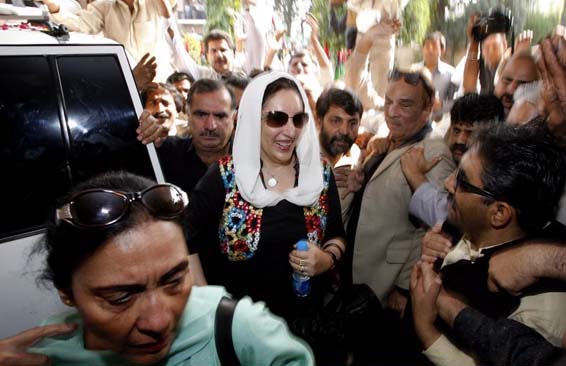
Looks rather tense and worried about the future of her country, doesn't she? (Source: The Guardian)
Finally, from the IHT comes this gem:
Earlier in the day, Syeda Abida Hussain, a former Pakistani ambassador to the United States and a member of Bhutto's party, said that foreign officials have said that they saw little popular opposition to Musharraf's decree, but that the protests would demonstrate that this was wrong. "The international community is saying we don't see a popular protest," she said. "So now we're going to make a protest."
And so BB moves in to hijack the nascent democracy movement....
UPDATE: Its still tough to get a full sense of what BB was up to in Islamabad yesterday. The media blackout is so frustrating! This is what I can piece together from news reports in the press today. The PPP was in Islamabad to attend a meeting of the ARD (the Alliance for the Restoration of Democracy which was a platform on which all opposition political parties are represented.) I try to untangle the mess here.
On Updates...
Teeth Maestro is providing some good minute by minute updates on the anti-emergency protests in Pakistan.
And if you are wondering what it is like to be on the run from the police, check this article out. Why doesn't Farooq Tariq (of the Labour Party of Pakistan (LPP)) want to go to jail? Because he has enjoyed the hospitality of the government before.
Kamila Shamsie glumly compares Musharaf's speeches after the 1999 coup with the more recent one.
Imran Khan is also in hiding and sending out messages to the public to "encourage" resistance. As usual, he is aiming most of his invective against the United States. Let us recall that he belongs to the 'everything is the United States' fault and if the U.S. would only leave well enough alone, all would be right with the world' school of thought. Oddly enough all the retired military types who pad out his political party's leadership are all still roaming about free.
As expected, the western media is now beginning to present BB as a fearless saviour of democracy taking on the evil dictator. Its vital that she hold her rally, even if it gets suicide bombed, so that she can claim to the west that she's bringing the people out into the streets in support of democracy!
Pathetic!
Finally, perhaps one of the greatest drawbacks about the media ban is that we can no longer experience the fun-filled pleasures of watching Fox News and chortle over their expert analysis, such as this: Hamid Karzai is the leader of Pakistan... no, wait, its Nawaz Sharif!
And if you are wondering what it is like to be on the run from the police, check this article out. Why doesn't Farooq Tariq (of the Labour Party of Pakistan (LPP)) want to go to jail? Because he has enjoyed the hospitality of the government before.
Kamila Shamsie glumly compares Musharaf's speeches after the 1999 coup with the more recent one.
Imran Khan is also in hiding and sending out messages to the public to "encourage" resistance. As usual, he is aiming most of his invective against the United States. Let us recall that he belongs to the 'everything is the United States' fault and if the U.S. would only leave well enough alone, all would be right with the world' school of thought. Oddly enough all the retired military types who pad out his political party's leadership are all still roaming about free.
As expected, the western media is now beginning to present BB as a fearless saviour of democracy taking on the evil dictator. Its vital that she hold her rally, even if it gets suicide bombed, so that she can claim to the west that she's bringing the people out into the streets in support of democracy!
Pathetic!
Finally, perhaps one of the greatest drawbacks about the media ban is that we can no longer experience the fun-filled pleasures of watching Fox News and chortle over their expert analysis, such as this: Hamid Karzai is the leader of Pakistan... no, wait, its Nawaz Sharif!
Saturday, 3 November 2007
Bits and Bobs and BB
Most outlandish statement of the day award goes to Shabaz Sharif, (brother of Nawaz Sharif who is now once again enjoying the hospitality of the Saudi government), who mentioned in a speech that he would like to see Bangladesh become part of Pakistan once again! What planet is he living one again?
CBS' 60 Minutes has finally 'outed' the intelligence source "curveball", who was the source that the American government based their allegations of Iraqi mobile chemical weapon laboratories on. The neocons still insist that Iraq had WMD.
The Grand Strategy Blog tries to figure out why BB is "so" popular in Pakistan. I have some alternative suggestions, but nows not the time to get into them. I would question though, whether she is as popular as the blogger seems to suggest. I would suggest that the PPP is more popular than BB herself is in Pakistan and that has something to do with building organized mass movements. As for her popularity in the western media - it may have something to do with the $250,000 PR campaign she launched to build up her image as this informative blog reports.
I should note here that I am undecided about which way I will vote in the coming elections, and that the PPP is one possibility. If I do vote for the PPP though, it will be despite Benazir Bhutto, not because of her. After all, as William Dalrymple wrote in the Guardian:
And here is a BBC article reminding us that even though the BB-Musharaf deal has led to the dropping of all the corruption cases against her and her husband in Pakistan, there are still plenty of cases abroad, including her involvement in the oil-for-food scandal in Iraq which allowed Saddam Hussain to evade sanctions and build up his personal wealth. Funny that the American media doesn't latch onto that one...
CBS' 60 Minutes has finally 'outed' the intelligence source "curveball", who was the source that the American government based their allegations of Iraqi mobile chemical weapon laboratories on. The neocons still insist that Iraq had WMD.
The Grand Strategy Blog tries to figure out why BB is "so" popular in Pakistan. I have some alternative suggestions, but nows not the time to get into them. I would question though, whether she is as popular as the blogger seems to suggest. I would suggest that the PPP is more popular than BB herself is in Pakistan and that has something to do with building organized mass movements. As for her popularity in the western media - it may have something to do with the $250,000 PR campaign she launched to build up her image as this informative blog reports.
I should note here that I am undecided about which way I will vote in the coming elections, and that the PPP is one possibility. If I do vote for the PPP though, it will be despite Benazir Bhutto, not because of her. After all, as William Dalrymple wrote in the Guardian:
Few would argue with the proposition that democracy is almost always preferable to dictatorship; but it is often forgotten the degree to which Bhutto is the person who has done more than anything to bring Pakistan's strange variety of democracy - really a form of elective feudalism - into disrepute. During her first 20-month long premiership, astonishingly, she failed to pass a single piece of major legislation. Her reign was marked by massive human rights abuse: Amnesty International accused her government of having one of the world's worst records of custodial deaths, extrajudicial killings and torture. Bhutto's premiership was also distinguished by epic levels of corruption. In 1995 Transparency International named Pakistan one of the three most corrupt countries in the world. Bhutto and her husband, Asif Zardari - widely known as "Mr 10%" - faced allegations of plundering the country.
And here is a BBC article reminding us that even though the BB-Musharaf deal has led to the dropping of all the corruption cases against her and her husband in Pakistan, there are still plenty of cases abroad, including her involvement in the oil-for-food scandal in Iraq which allowed Saddam Hussain to evade sanctions and build up his personal wealth. Funny that the American media doesn't latch onto that one...
Benazir vs. Jemima: Round II
I've been a little slow to pick up on this one, but its interesting nonetheless. Recently, Jemima Khan, ex-wife of Imran Khan wrote an op-ed piece blasting the western media's fawning acceptance of Bhutto's self-projected image as the saviour of democracy in Pakistan. There is, of course, history between the two, given BB's personal attacks on Jemima during the 1996 campaign, but everything Jemima has to say is true.
Of course the article could not go unanswered, and an editorial in the Daily Times - a Pakistani mouthpiece for the PPP - launched a counter-attack. Once again, the points raised in Jemima's article are ignored and the article seeks to discredit Jemima personally. There are some interesting reflections on the episode on the Indian policy blog, The Acorn.
Of course the article could not go unanswered, and an editorial in the Daily Times - a Pakistani mouthpiece for the PPP - launched a counter-attack. Once again, the points raised in Jemima's article are ignored and the article seeks to discredit Jemima personally. There are some interesting reflections on the episode on the Indian policy blog, The Acorn.
Subscribe to:
Posts (Atom)

