How does humanitarian intervention work? Darfur is much on everyone's minds these days and humanitarian intervention is once more in demand. Alas, there seems to be some disagreement about how to go about intervening.
Pansy-ass programmes to provide humanitarian aid by naive goody-goodies is obviously not the American way of humanitarian intervention. We need real action here! The saying about good intentions and the paving on the road to An Uncomfortably Warm Place comes to mind.
I was all set to have a big post on Darfur, but I confess that I'm a little numbed. The uses and abuses of history, of the media; the sheer bloody, rampaging triumph of ignorance; the self-serving cynicism of the moral high ground... it just all gets me down.
But riddle me this: what is to be done when a government starts arming a variety of militias to ethnically cleanse areas in a region under its control, encourages slavery, and promotes bitter warfare with militias of other ethnic groups, leading to well over half a million deaths, almost four million displaced refugees (sorry, five million) and a humanitarian crisis spread over several countries?
Ans: Why, you distract attention by voicing concern about the plight of the poor victims of the fighting in Sudan of course (and back the group that refuses to stop fighting). Never mind the complexities of the situation.
IZ
Edit: Maybe the USA and Sudan have more in common than we knew?
Monday, 11 June 2007


Authorities Hit Upon Solution to Guantanomo Legal Chaos
Last week the Bush administrations bungling attempts to try the inmates at Guantanamo Bay received another blow when a judge ruling made mockery of the military tribunal system that was invented last year.
The legal chaos surrounding the Guantanamo detainees - just about all of whom are "smallfry" foot soldiers or simply bystanders who got swept up in the military operations in Afghanistan - has become a severe source of embarrassment. The problem the Bush government has is, quiet simply, how does it make this problem go away? It can't release the detainees because that would be admitting that they never had any case for holding them in the first place, unless the prisoner agrees to plead guilty in return for their freedom (that is precisely what happened in April with the Australian detainee, David Hicks). It can't try them in anything other than the most blatant of kangaroo courts which they are having trouble creating in the U.S. So what to do?
Well obviously here is the answer. Make detainees so miserable that they take their own lives. Its not as if it hasn't happened many times before. Ah, but there is an insidious side to this! Obviously these terrorists are engaged in terrorism when they commit suicide. As the IHT soberly reports:
Devious, these terrorists, aren't they?
IZ
The legal chaos surrounding the Guantanamo detainees - just about all of whom are "smallfry" foot soldiers or simply bystanders who got swept up in the military operations in Afghanistan - has become a severe source of embarrassment. The problem the Bush government has is, quiet simply, how does it make this problem go away? It can't release the detainees because that would be admitting that they never had any case for holding them in the first place, unless the prisoner agrees to plead guilty in return for their freedom (that is precisely what happened in April with the Australian detainee, David Hicks). It can't try them in anything other than the most blatant of kangaroo courts which they are having trouble creating in the U.S. So what to do?
Well obviously here is the answer. Make detainees so miserable that they take their own lives. Its not as if it hasn't happened many times before. Ah, but there is an insidious side to this! Obviously these terrorists are engaged in terrorism when they commit suicide. As the IHT soberly reports:
The former commander of the detention facilities, Rear Admiral Harry Harris of the U.S. Navy, described earlier suicides as acts of "asymmetric warfare" - an effort to increase condemnation of the prison.
Devious, these terrorists, aren't they?
IZ
How to Escalate Civil Wars 101
Here's an interesting article from the International Herald Tribune: 'U.S. Arming Sunnis in Iraq to Battle Old Qaeda Allies'. Essentially it relates how the U.S. military, delighted by infighting between Sunni nationalist militias and Sunni Jihadist militias has decided to arm the nationalists and turn a blind eye to their activities according to the dictum 'the enemy of my enemy, who is also my enemy and the enemy of my allies (who are also allies of another of my enemies) is my friend'. Guardian photojournalist Sean Smith witnessed the phenomenon which he recorded here amongst a series of other disturbing photos from Iraq.
After quoting glowing reports of success from American military commanders, the IHT article goes on to note:
The question is: who will the militias use these weapons against? Will it be the Americans? Or Shiites? Several months ago I had linked to this article which chronicled how many Sunni militias are leaving off attacking the Americans in order to attack Shiites. Last month, we learnt that Moqtada al-Sadr, the leader of the Shiite Mahdi army was looking to forge ties with Sunni militias to try and build a pan-Iraqi movement to oppose U.S. occupation.
One suspects that once the weapons and money are in the hands of various local militia leaders, there will be no control over how they are used and who they are used against. In the fluctuating political landscape of a chaotic post-invasion Iraq, today's ally can be tomorrow's enemy and vice versa. And of course one would be naive to assume that armed gangs only use violence for political ends. Armed robbery, kidnappings, turf wars and vendettas are always going to be the primary use of weapons in a land where there so so much physical and economic insecurity. The Americans' claim that creating more armed gangs would help "to stabilize Iraq, and to speed American troops on their way home." Obviously, the second goal is the main one, the first, merely lip-service. After all, what does the Iraqi government have to say about this?
But who cares what the Iraqi government wants? They should just shut up and enjoy the freedom they have been given.
IZ
After quoting glowing reports of success from American military commanders, the IHT article goes on to note:
But critics of the strategy, including some American officers, say it could amount to the Americans' arming both sides in a future civil war. The United States has spent more than $15 billion in building up Iraq's army and police force, whose manpower of 350,000 is heavily Shiite. With an American troop drawdown increasingly likely in the next year, and little sign of a political accommodation between Shiite and Sunni politicians in Baghdad, the critics say, there is a risk that any weapons given to Sunni groups will eventually be used against Shiites. There is also the possibility the weapons could be used against the Americans themselves.
The question is: who will the militias use these weapons against? Will it be the Americans? Or Shiites? Several months ago I had linked to this article which chronicled how many Sunni militias are leaving off attacking the Americans in order to attack Shiites. Last month, we learnt that Moqtada al-Sadr, the leader of the Shiite Mahdi army was looking to forge ties with Sunni militias to try and build a pan-Iraqi movement to oppose U.S. occupation.
One suspects that once the weapons and money are in the hands of various local militia leaders, there will be no control over how they are used and who they are used against. In the fluctuating political landscape of a chaotic post-invasion Iraq, today's ally can be tomorrow's enemy and vice versa. And of course one would be naive to assume that armed gangs only use violence for political ends. Armed robbery, kidnappings, turf wars and vendettas are always going to be the primary use of weapons in a land where there so so much physical and economic insecurity. The Americans' claim that creating more armed gangs would help "to stabilize Iraq, and to speed American troops on their way home." Obviously, the second goal is the main one, the first, merely lip-service. After all, what does the Iraqi government have to say about this?
An Iraqi government official who was reached by telephone on Sunday said the government was uncomfortable with the American negotiations with the Sunni groups because they offered no guarantee that the militias would be loyal to anyone other than the American commander in their immediate area. "The government's aim is to disarm and demobilize the militias in Iraq," said Sadiq al-Rikabi, a political adviser to Maliki. "And we have enough militias in Iraq that we are struggling now to solve the problem. Why are we creating new ones?"
But who cares what the Iraqi government wants? They should just shut up and enjoy the freedom they have been given.
IZ
Friday, 8 June 2007
The Destruction of Culture
From an article by Simon Jenkins in the Guardian:
IZ
And on top of all this, the Salafist fundo militant groups have started a campaign to destroy Iraq's many shrines and tombs including the tomb of Ezekiel where Jews and Muslims used to worship together right up till 2003. Sigh.Hussaini confirmed a report two years ago by John Curtis, of the British Museum, on America's conversion of Nebuchadnezzar's great city of Babylon into the hanging gardens of Halliburton. This meant a 150-hectare camp for 2,000 troops. In the process the 2,500-year-old brick pavement to the Ishtar Gate was smashed by tanks and the gate itself damaged. The archaeology-rich subsoil was bulldozed to fill sandbags, and large areas covered in compacted gravel for helipads and car parks. Babylon is being rendered archaeologically barren.
Meanwhile the courtyard of the 10th-century caravanserai of Khan al-Raba was used by the Americans for exploding captured insurgent weapons. One blast demolished the ancient roofs and felled many of the walls. The place is now a ruin.
Outside the capital some 10,000 sites of incomparable importance to the history of western civilisation, barely 20% yet excavated, are being looted as systematically as was the museum in 2003. When George tried to remove vulnerable carvings from the ancient city of Umma to Baghdad, he found gangs of looters already in place with bulldozers, dump trucks and AK47s.
IZ
Cuban Doctors
The Cuban Healthcare system seems to be drawing a good deal of attention these days. It features prominently in Michael Moore's new documentary, Sicko. Slate ran a short explainer on why there are so many Cuban doctors all over the world. Its interesting that Cuba, despite being so heavily sanctioned, is on the cutting edge of Cancer research and other Biotechnologies.
This comprehensive article talks about how Cuba is beginning to export its medical system to other poor central American nations, and also notes how it provides scholarships for poor students from around the world, (including the U.S.).
Cuban doctors and medical teams are always amongst the first to arrive at sites afflicted by natural disasters, and often the last to leave. They made a big impact in Pakistan after the horrific earthquake in 2005 - several thousand volunteers treating over 1.7 million patients! Here is an article from an Indian current affairs magazine on the Cuban initiative. Sharmeen Obaid kept a diary when she volunteered as a translator during the relief efforts, which you can read here.
IZ
This comprehensive article talks about how Cuba is beginning to export its medical system to other poor central American nations, and also notes how it provides scholarships for poor students from around the world, (including the U.S.).
Cuban doctors and medical teams are always amongst the first to arrive at sites afflicted by natural disasters, and often the last to leave. They made a big impact in Pakistan after the horrific earthquake in 2005 - several thousand volunteers treating over 1.7 million patients! Here is an article from an Indian current affairs magazine on the Cuban initiative. Sharmeen Obaid kept a diary when she volunteered as a translator during the relief efforts, which you can read here.
IZ
Tuesday, 5 June 2007
The G8 Summit
My favourite photo from the G8 Summit protest last weekend (from a BBC photo-essay):

Here's another (from indymedia):

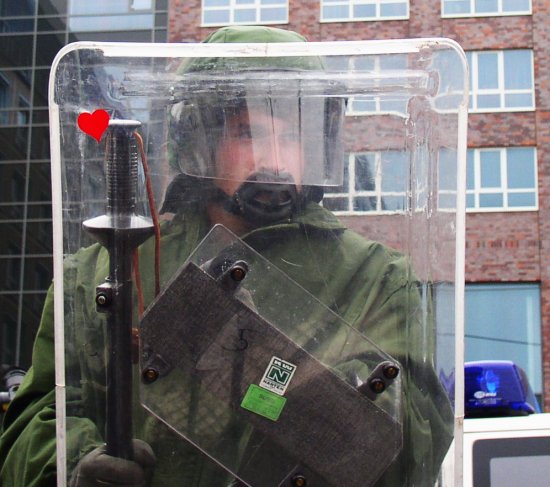
Also from indymedia. I love the little sticker someone put up on this shield:

There were attempts to bribe the police to change sides:

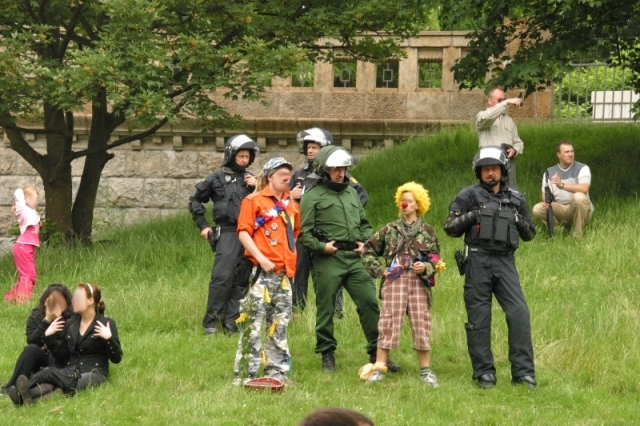
Some members of the clown army attempted to barricade the barricaders:

The G8 kings were also on tour:
 You can see more of the G8 kings on tour as well as some of the other creative protest banners/installations/costumes here.
Now here is a photo of the incident that sparked off the clashes between the police and some of the protesters. These two guys are plain-clothes policemen and they jumped the guy on the ground in the front as a crowd was gathering to listen to the concert. The other fellow on the ground came rushing in to help and these guys called in the snatch squad that had gathered nearby. The riot police waded in which sparked off the clashes. The incident has actually been caught on video and can be found here. The commentary is in German, so, if like me you don't speak the language, it gets interesting about 2 minutes in.
 What's interesting is that the rally had been completely peaceful up to then. The police, I suppose would say they were trying to head off trouble by snatching potential troublemakers before anything started, but their tactics were provocative, and in the eyes of many who were there, deliberately calculated to disrupt the protests. A brief description of the clashes and photos can be found at indymedia here.
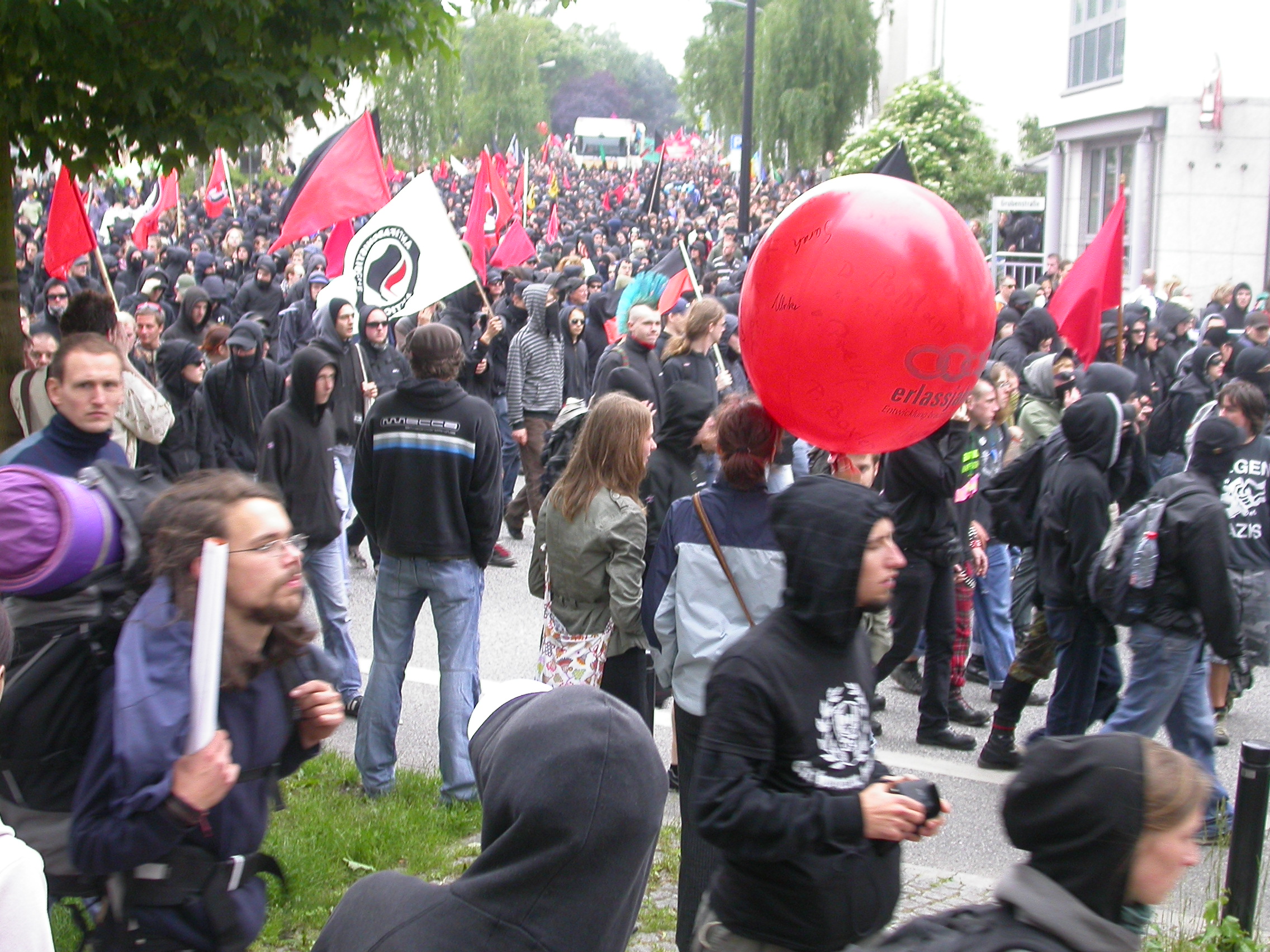
The police was quick to blame the violence on the blak-bloc - an anarchist group that has often clashed violently with police at various anti-capitalist demonstrations. Here's a picture of their contingent:

But the way the German police handled things has also come into criticism. At the G8 summit in the UK in 2005, the British police had surrounded the blak-block contingent, not letting them march. The clandestine rebel insurgent clown army intervened and rather than face off with the protesters, the police allowed them to march, thereby avoiding any violent confrontation [A somewhat grainy video still presentation of this incident can be viewed here.] You can see videos of the clown army in action here and here. But this video of them in action in Germany is awesome:
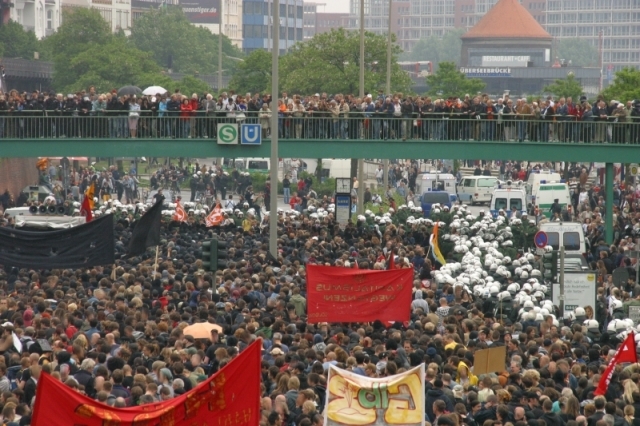
The run-up to the weekend protest had already foreshadowed trouble. The German police had come in for criticism even in the mainstream media for its series of raids in early May of various leftist organisations who were gearing up for the G8 summit. Then in a small protest in Hamburg on 28th May police provocations had led to clashes and the march being called off early in protest of police tactics - such as the use of snatch squads against individuals breaking minor rules (covering one's face, having the wrong size billboard etc.). When the demonstration broke up, the participants found themselves surrounded and hemmed in by the police. While some groups tried to break out, others just sat on the street, waiting to be allowed to leave. You can see from this photograph how the protest got hemmed in:

The police getting crucial reinforcements:

Here's a report on the Hamburg demo. What was clear was that the police were not planning on playing nice at the weekend G8 demo and that obviously had something to do with the violence that broke out. According to the Guardian, 16,000 police are being deployed for the coming week of demonstrations in order to "halt violence".
Good luck with that.
IZ
P.S.: The BBC website has a basic primer on why people are protesting against the G8.

Here's another (from indymedia):

Also from indymedia. I love the little sticker someone put up on this shield:
There were attempts to bribe the police to change sides:

Some members of the clown army attempted to barricade the barricaders:

The G8 kings were also on tour:
 You can see more of the G8 kings on tour as well as some of the other creative protest banners/installations/costumes here.
Now here is a photo of the incident that sparked off the clashes between the police and some of the protesters. These two guys are plain-clothes policemen and they jumped the guy on the ground in the front as a crowd was gathering to listen to the concert. The other fellow on the ground came rushing in to help and these guys called in the snatch squad that had gathered nearby. The riot police waded in which sparked off the clashes. The incident has actually been caught on video and can be found here. The commentary is in German, so, if like me you don't speak the language, it gets interesting about 2 minutes in.
 What's interesting is that the rally had been completely peaceful up to then. The police, I suppose would say they were trying to head off trouble by snatching potential troublemakers before anything started, but their tactics were provocative, and in the eyes of many who were there, deliberately calculated to disrupt the protests. A brief description of the clashes and photos can be found at indymedia here.
The police was quick to blame the violence on the blak-bloc - an anarchist group that has often clashed violently with police at various anti-capitalist demonstrations. Here's a picture of their contingent:
But the way the German police handled things has also come into criticism. At the G8 summit in the UK in 2005, the British police had surrounded the blak-block contingent, not letting them march. The clandestine rebel insurgent clown army intervened and rather than face off with the protesters, the police allowed them to march, thereby avoiding any violent confrontation [A somewhat grainy video still presentation of this incident can be viewed here.] You can see videos of the clown army in action here and here. But this video of them in action in Germany is awesome:
The run-up to the weekend protest had already foreshadowed trouble. The German police had come in for criticism even in the mainstream media for its series of raids in early May of various leftist organisations who were gearing up for the G8 summit. Then in a small protest in Hamburg on 28th May police provocations had led to clashes and the march being called off early in protest of police tactics - such as the use of snatch squads against individuals breaking minor rules (covering one's face, having the wrong size billboard etc.). When the demonstration broke up, the participants found themselves surrounded and hemmed in by the police. While some groups tried to break out, others just sat on the street, waiting to be allowed to leave. You can see from this photograph how the protest got hemmed in:
The police getting crucial reinforcements:
Here's a report on the Hamburg demo. What was clear was that the police were not planning on playing nice at the weekend G8 demo and that obviously had something to do with the violence that broke out. According to the Guardian, 16,000 police are being deployed for the coming week of demonstrations in order to "halt violence".
Good luck with that.
IZ
P.S.: The BBC website has a basic primer on why people are protesting against the G8.
Subscribe to:
Posts (Atom)

